Filter Lanes, Turning Rules and Junction Etiquette in Singapore: The Mistakes That Cost Test Points
· 7 min read
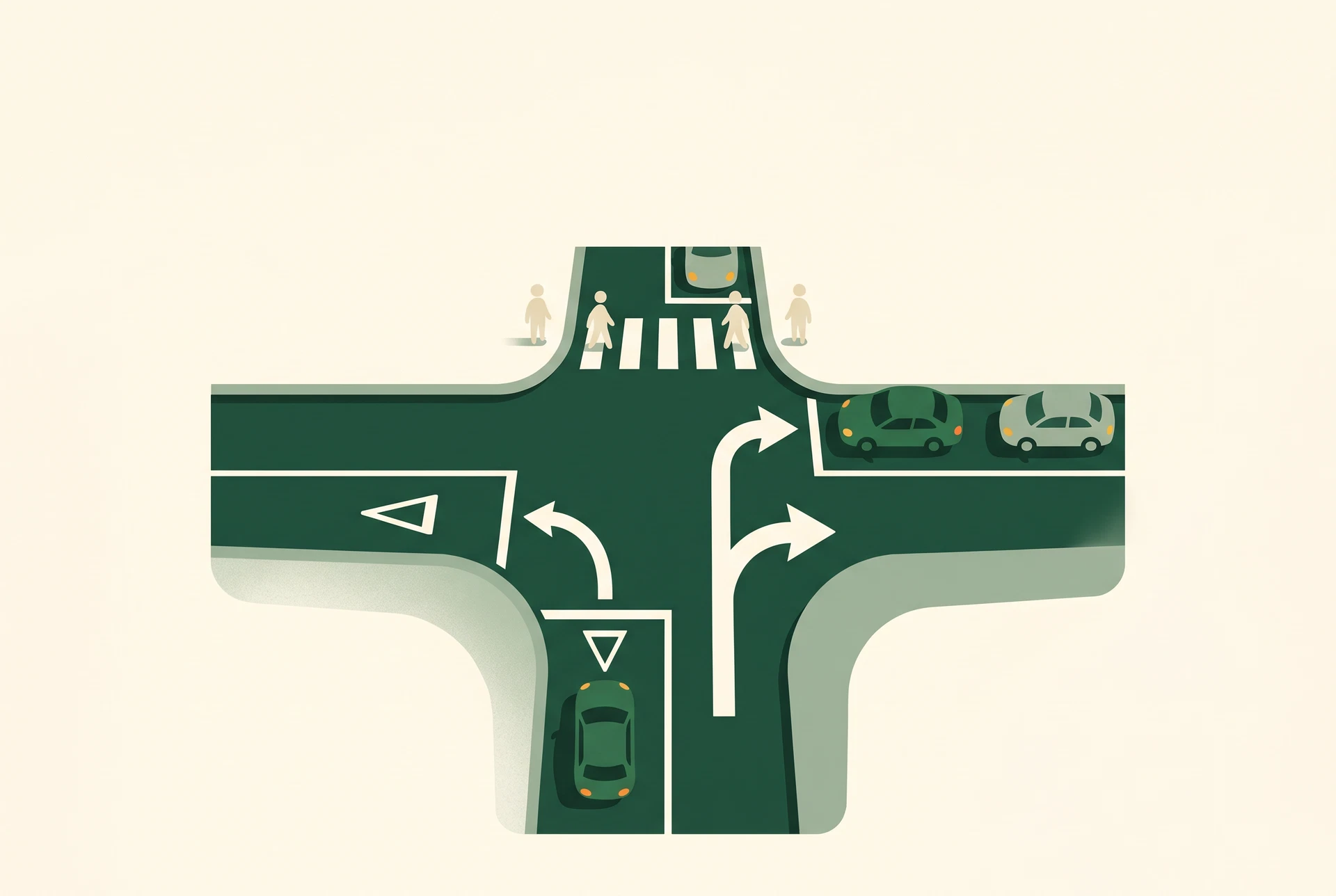
Junctions are where roads get busy — and where misunderstandings are most expensive. Beliefs like "green means I can just turn" or "a filter lane means go" lose marks in the BTT, fail candidates in the road test, and cause real collisions. This article untangles the junction rules most often gotten wrong in Singapore.
Misconception one: a green light lets you turn freely
A green light is permission to proceed, not absolute priority. When turning at a green, you must still give way to two parties: oncoming straight-through traffic (when turning right) and pedestrians crossing the road you are turning into. The turning driver yields — that is the default, and it is exactly what both the theory test and the road test probe. Unless you have a green arrow specifically for your turn, treat every turn as a negotiation, not an entitlement.
Misconception two: filter lanes mean "go"
A filter lane lets you turn left without waiting for the main signal — but it is a give-way arrangement, not a priority lane. Before entering the main road you must yield to traffic already on it, and to pedestrians crossing the filter path. The give-way line (broken white lines) at the end of the filter is legally meaningful: be prepared to stop there. "Charging the filter" — sweeping through at speed without checking — is one of the most common causes of side-swipe collisions at Singapore junctions.
The discretionary right turn
At many cross junctions you turn right on a full green only when a safe gap exists in oncoming traffic — creeping forward to the turning pocket, waiting, and completing the turn when clear (or when the light turns amber and oncoming traffic stops). Two errors dominate here: turning too eagerly across insufficient gaps, and conversely refusing to enter the turning pocket at all, which blocks everyone behind. Enter the pocket, wait with wheels straight, and take the gap decisively when it comes.
Who gives way to whom: the quick table
| Situation | You give way to |
|---|---|
| Turning vs oncoming straight traffic | The straight-through vehicle |
| Turning vs pedestrians on the target road | The pedestrians |
| Entering a roundabout vs circulating traffic | Traffic already in the roundabout (from your right) |
| Joining a main road from a minor road | Traffic on the main road |
These four rows cover the overwhelming majority of junction give-way questions. The underlying intuition — the one moving into a space yields to the one already in it — rarely steers you wrong.
Signals: early, clear, cancelled
The most neglected junction detail is signalling discipline. Three habits: signal early (give others time to react), signal clearly (no half-flashes), and cancel promptly (a forgotten indicator misleads everyone around you). In the road test, late signals, missing signals and forgotten cancellations all cost points; on real roads they cost trust — other drivers plan around what your indicators claim.
The junction mindset: two seconds is cheap
Most junction collisions share a root cause: someone tried to save two seconds. The habit that keeps you safe — and passes tests — is assuming the junction owes you nothing: look, yield where required, and take your turn cleanly when it is genuinely yours.
FAQ
Do I give way to pedestrians even with a green light? When turning, yes — pedestrians crossing the road you are turning into have priority.
Is stopping in a filter lane wrong? No — the give-way line exists precisely so you can stop when the main road is not clear. Failing to stop when needed is the error.
Further reading: our guides on traffic lights and signals, and roundabout give-way rules. Junction rules are prime BTT territory — drill the give-way questions here until they are reflex.