Getting a Class 2B Motorcycle Licence in Singapore: How It Differs from a Car Licence, and Who It Suits
· 7 min read
Not everyone needs — or wants — a car licence. For many commuters, a motorcycle is nimbler, cheaper to run, and far easier to park. The Class 2B licence is the entry point for riding in Singapore. Its structure overlaps with the car licence in some places and differs sharply in others; this guide walks through both, plus the progression system and who 2B genuinely suits.
Same theory, different practice
The similarity first: the theory gate is identical. Class 2B candidates take the same Basic Theory Test (BTT) as car learners — the same signs, the same right-of-way rules, the same 45-out-of-50 pass bar. If you practise BTT questions on this site, they count fully toward a motorcycle licence.
The differences are in the practical pipeline:
| Stage | Car (Class 3/3A) | Motorcycle (Class 2B) |
|---|---|---|
| Basic theory | BTT | BTT (shared) |
| Eyesight / colour test | Required | Required |
| Circuit assessment | Parking, slope, S-course | Balance drills: slow riding, narrow plank, slalom |
| Road assessment | Car road test | Motorcycle road test |
| Minimum age | 18 (Class 3) | 18 (Class 2B) |
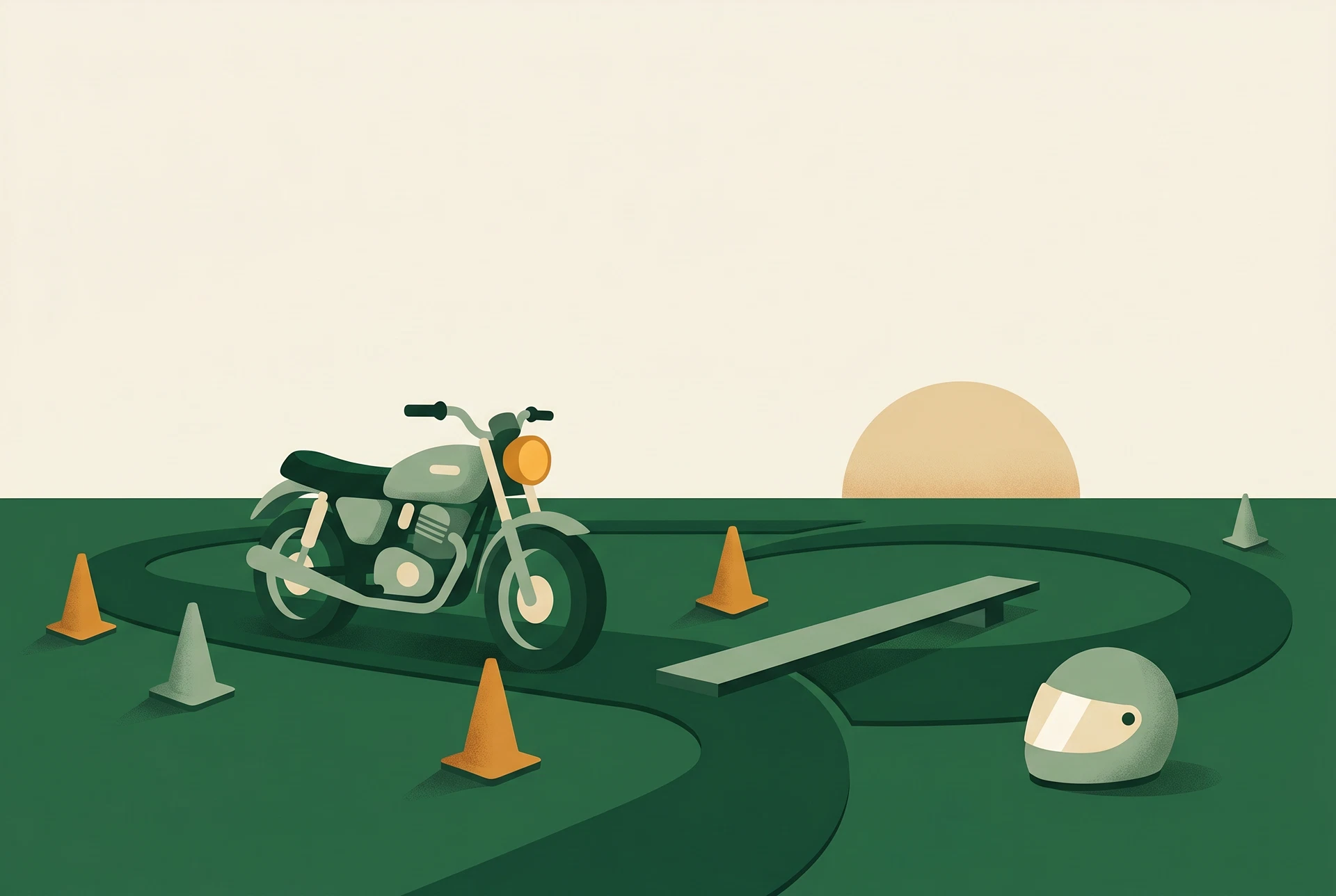
The biggest practical difference is balance work. The 2B circuit includes slow riding, the narrow plank and cone slaloms — low-speed control drills that have no car equivalent, and that consume most of a new rider's practice time.
The 2B → 2A → 2 ladder
Singapore staggers motorcycle licences by engine capacity, and you must climb the ladder in order. Class 2B is the entry tier for smaller-capacity bikes from age 18. Class 2A requires holding 2B for a qualifying period before you can ride mid-capacity machines. Class 2, the top tier, requires time on 2A first. The design intent is simple: match rider experience to engine power, and keep new riders off the biggest bikes. If your dream machine is large-capacity, budget years, not months.
Who should choose 2B
Two wheels make sense if your commute is moderate, congestion-prone, and parking-constrained — the motorcycle's advantages compound in exactly those conditions. It makes less sense if you regularly carry family, need weather protection, or do long-distance drives. Decide based on your actual usage pattern, not on which licence looks easier; neither is trivially easy, and they optimise for different lives.
One honest warning: defensive riding is not optional
Riders are the most exposed party in any collision. The theory-test material on following distance, blind spots and giving way is, for a rider, not exam trivia — it is survival technique. Assume you are invisible to drivers, stay out of lorry blind spots, and treat every junction as a place where someone may fail to see you.
FAQ
Do I need to pass BTT for a motorcycle licence? Yes — BTT is the shared theory gate for both cars and motorcycles.
Can I skip straight to a big bike? No. The 2B → 2A → 2 progression is mandatory, with a qualifying period at each tier.
What is the hardest part of the 2B course? Almost universally the low-speed balance drills — slow riding, the plank and the slalom. Expect to spend most of your circuit hours there.
Further reading: our guides on defensive driving and blind spots, and the complete BTT guide. Whether you choose two wheels or four, theory comes first — get the BTT done here.